Chapter 10 - HER CHAIR
Chapters · 10 of 10
Two years after the first Easter, Keller Heritage Living opened Margaret House.
It was not the largest project in the company's history.
It was the one I cared about most.
A seventy-two-unit assisted-living community built on land my mother had once considered purchasing.
Anita insisted we name it after her.
I resisted.
She won.
The opening ceremony was intentionally small.
Residents.
Staff.
Local officials.
My family.
Some of it.
Richard attended.
Patricia attended.
Clara, now seven, wore a blue dress and carried the ribbon-cutting scissors as though she had been entrusted with national security.
Katherine did not come.
She and I had spoken three times in two years.
The third conversation had been different.
No accusation.
No company.
She told me she had started working with a smaller housing developer.
Not as CEO.
As a regional operations director.
“I hate having a boss,” she admitted.
“I imagine you do.”
“She tells me no.”
“That sounds traumatic.”
Katherine almost laughed.
Then she said, “I was awful to Clara.”
Not stressed.
Not provoked.
Not misunderstood.
Awful.
“Yes.”
“I'm not asking to see her.”
“Good.”
“I just wanted to say it correctly once.”
That conversation didn't repair us.
But it was the first one that made repair conceivable.
At Margaret House, Anita led us through the lobby before the ceremony.
Near the main window sat an ordinary wooden chair.
Nothing luxurious.
Wide arms.
Firm cushion.
Proper height.
I knew immediately.
“You did this.”
Anita smiled.
“Your mother's test.”
Clara climbed onto it.
I laughed.
“Sit properly.”
“I am.”
She swung her feet.
Richard stood several yards away watching her.
Something moved across his face.
Maybe he remembered Easter too.
Clara patted the empty space beside her even though there wasn't enough room.
“Mom.”
“What?”
“This chair is good.”
“Why?”
“I can get up.”
She demonstrated.
Sat.
Stood.
Sat again.
My mother would have approved.
The ceremony began ten minutes later.
I gave a short speech.
I talked about Margaret's belief that dignity was designed into small decisions.
Door widths.
Lighting.
Handrails.
Staffing.
Chairs.
I did not mention Katherine.
I did not mention Easter.
I didn't need to.
Afterward, Richard approached me.
“Your mother would be proud.”
For once, I accepted the sentence without arguing over whether he could know.
“Thank you.”
He looked toward Clara.
“She changed everything, didn't she?”
I thought about that.
“No.”
He frowned.
“She showed me what was already there.”
Richard nodded slowly.
That afternoon, after everyone left, Clara and I walked through the empty lobby once more.
The sunlight had shifted across the floor.
She climbed into Margaret's chair again.
“Can we take it home?”
“No.”
“Why?”
“It belongs here.”
She sighed dramatically.
Then looked up at me.
“Who owns this place?”
It was exactly the kind of question children ask after spending too much time around businesspeople.
“Lots of people, technically.”
“Do you?”
“Part of it.”
“Grandpa?”
“Part of it.”
“Aunt Katherine?”
“A very small part.”
Clara thought.
“Then whose chair is it?”
I smiled.
“No one's.”
She frowned.
“What?”
“It belongs to whoever needs to sit down.”
She seemed satisfied by that answer.
Then she climbed off and took my hand.
As we walked toward the doors, I glanced back at the chair.
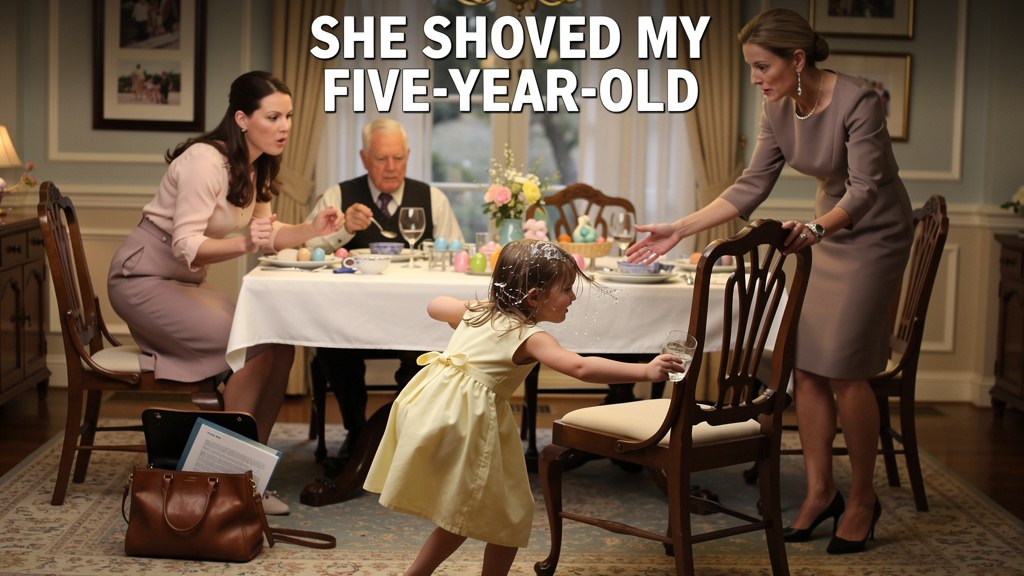
Two years earlier, my sister had shoved my daughter to the floor because she believed a chair mattered more than a child.
For most of my life, my father had done something similar with power.
He had treated positions, companies and authority as possessions that determined whose voice counted.
I had nearly learned the same lesson from him.
The acquisition documents in my handbag had changed what happened that Easter.
But they were not what gave me power.
The important thing had happened several seconds earlier.
I had looked at my daughter crying on the floor.
I had looked at the people waiting for me to tolerate it.
And I had decided we were leaving before I knew whether anyone would follow.
Everything after that—the company, the board, Katherine's termination, Richard's apology—was consequence.
The choice came first.
Clara squeezed my fingers.
“Mom?”
“Yes?”
“Can we get pancakes?”
I laughed.
“Again?”
“It's Sunday.”
Apparently that settled it.
We stepped outside together.
And this time, there was no chair in the world important enough to make me stay where my daughter wasn't safe. ```